
The most feared HYROX station is also where most athletes lose the most time. Here's how to execute your 80 metres of burpee broad jumps cleanly, without blowing up.
HYROX Burpee Broad Jumps: why this station drains you more than any other
You hit station 7. Your legs are burning after sled push, sled pull and the rower. In front of you, 80 metres to cover. Not by running. By burpee broad jumps. Each rep means going to the floor, exploding back up, jumping forward. Multiply that by about 22 reps, and you'll see why this station costs anywhere from 30 seconds to 2 minutes depending on your level.
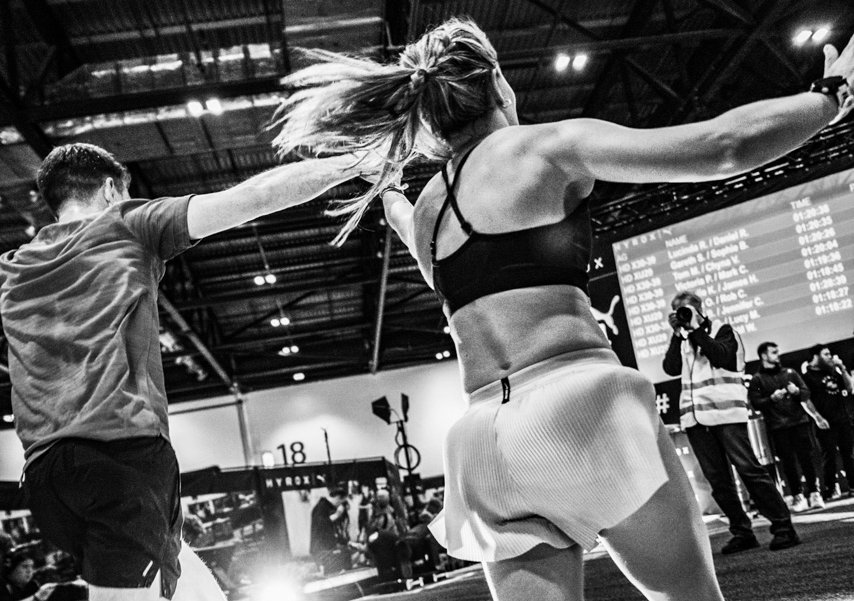
The good news is that burpee broad jumps respond massively to technique. More than sled push, more than wall balls. A technically prepared athlete will close out the 80 metres in 3:30 while another, theoretically stronger, will need 5 minutes because they over-recruit useless chains on every rep.
What's actually happening in your body
The burpee broad jump combines three different efforts:
- A controlled drop to the floor that hits your triceps and pecs as you absorb.
- An explosive push back up that requires your quads and posterior chain to fire at peak power.
- A forward jump that mobilises glutes, hamstrings and calves in plyometric mode.
Three times per rep. For 22 reps. With your heart already at 90% of max. That's an explosive cocktail, and that's why the station scares people.
The technique in 4 phases
Phase 1: the drop
Hands to the floor at shoulder width, kick the feet back in a single movement. Keep the pelvis aligned, don't let your hips collapse. Your chest touches the floor (HYROX standard requires chest-thigh-feet contact). The point isn't to go down slowly, it's to go down cleanly.
Phase 2: re-stacking the feet
This is where most athletes lose the most time. Instead of bringing your feet in two beats (a hop then a reposition), train yourself to bring them directly under the pelvis in a single tucked jump. Knees come up toward the chest, feet land just ahead of the hands, ready to push.
Phase 3: propulsion
You don't need to fully stand up. While your back is still slightly angled forward, throw your arms forward and up, and explode through the hips. The arm swing initiates the jump, not the leg contraction.
Phase 4: landing
Land in athletic position: feet apart, knees slightly bent, core engaged. Drop your hands immediately for the next rep. No standing pause. The transition between landing and dropping is what separates a 3:30 broad jump from a 5 minute one.
The mistakes that cost you time
Jumping too far
The HYROX standard asks you to cover 80 metres with a minimal symbolic jump (you must clear the jump bar, that's it). Jumping 1.80 m every rep instead of 1.30 m means fewer reps but much more expensive ones. The cost-energy ratio is unfavourable beyond 1.40 m.
Standing fully upright between reps
Every time you stand fully before dropping again, you make your quads work twice for nothing. Stay compact, shoulders above the pelvis but no higher.
Holding your breath
Many athletes hold their breath in the first reps out of focus. Result: by rep ten, they're hyperventilating and have to stop. Inhale on the drop, exhale on the propulsion, no exception.
How to train it specifically
The base session: short EMOMs
Once a week, run this simple session: 8 minute EMOM, 6 burpee broad jumps per minute. It teaches you cadence and forces you to keep recovery time between sets. When you finish the 8 minutes feeling like you could do 4 more, bump it to 7 reps per minute.
The HYROX-specific format
Every two weeks, run a block that simulates station 7 fatigue: 500 m of rowing at race pace, then 22 burpee broad jumps unbroken, then 400 m of running. Measure the total time. That's your progression marker.
Pure plyometric work
Twice a week, add 4x10 dry broad jumps (no burpee), looking for max distance, with 60 seconds of recovery. This builds the explosive force needed to keep phase 3 powerful even when fatigued.
Pacing strategy for station 7
On the previous run (the 7th km), resist the urge to push. That kilometre determines your ability to attack the burpees properly. Aim for a pace 5 to 10 seconds per km slower than your average, and arrive at the station with a heart rate that's coming down for the last 10 seconds.
For the 22 reps, don't break in theory. But allow yourself a micro-pause of 5 seconds at rep 12 or 13 if your technique starts to break down. A 5 second pause to restart cleanly is better than 30 seconds of bad reps that cost you the rest of the race.
On the run that follows, start slow. Your calves and hamstrings will scream for the first 200 metres. Jog, find your rhythm, accelerate from the 400 m mark.
Tracking your progress station by station
On ROXWALL, every station split is isolated in your results. Compare your burpee broad jumps time from race to race, and put it in perspective with your station ranking. That's what tells you if your specific training is paying off. Check your splits here.
And once you've put your best Burpee Broad Jumps time on the dashboard, keep it somewhere visible. A ROXWALL frame with your name, race and splits is also a daily reminder that this station no longer scares you. Build your HYROX frame.
Where's your patch?
You crossed the finish line, now display it. Create your custom hexagonal frame and turn your HYROX achievement into wall art.
BUILD MY FRAME